A men's dress pant marked "36-inch waist" measured anywhere from 37 to 41 inches across different retailers in a 2010 investigation - a five-inch spread on a number that's supposed to mean exactly one thing. For a private label brand, that inconsistency is not a curiosity, it's a direct margin problem: there's no national brand to absorb the blame when a size runs wrong, and no wholesale return policy to soften the cost of the fix. Fit consistency has to be engineered on purpose, starting with the grade rule.
Why This Is a Margin Problem, Not Just a Fit Problem
Sizing is one of the largest drivers of apparel returns, alongside color, quality, and style preference. A widely cited breakdown from Tessuti found that men's returns skew toward items running small, women's returns skew toward items running large, and children's apparel splits both ways.
| Category | Returned because too small | Returned because too large |
|---|---|---|
| Men's apparel | 23% | 15% |
| Women's apparel | 13% | 22% |
| Children's apparel | 31% | 16% |
Online apparel return rates commonly run 20-30%, well above the roughly 15-20% average across all e-commerce categories, and the cost of each one adds up fast - industry cost breakdowns put the fully loaded loss (reverse shipping, inspection and restocking, and markdown-to-clear on stock that doesn't resell at full price) at roughly half to two-thirds of the item's price. For apparel specifically, returns cost the US apparel industry an estimated $218 billion in a single recent year, per National Retail Federation data. Fit-driven returns aren't a customer service line item - they're a direct hit to the margin math covered in our profit-leak audit framework, and grading is one of the few return drivers a brand can actually engineer away.
How "Size 8" Stopped Meaning Anything Fixed
Grading problems compound on top of a sizing system that was never fully standardized to begin with. The classic illustration is a Sears dress with a 32-inch bust measurement: in Sears' 1937 catalog, that measurement was labeled a size 14. By 1967, the same measurement had become a size 8. By 2011, it was a size 0.
The size label assigned to the same 32-inch bust measurement in Sears catalogs, 1937 to 2011. The body didn't change; the label did. (Industry attempts to standardize this, like ASTM D5585, first published in 1995 and revised in 2011, came decades after "vanity sizing" competition was already underway.)
None of this is private label's fault - it's the legacy of decades of "vanity sizing" competition across the whole industry. But it means a private label brand can't borrow a competitor's size chart and assume it means the same thing to a customer. The size chart, and the grade rule that builds out from it, has to be deliberately set and then held consistent, order after order, factory after factory.
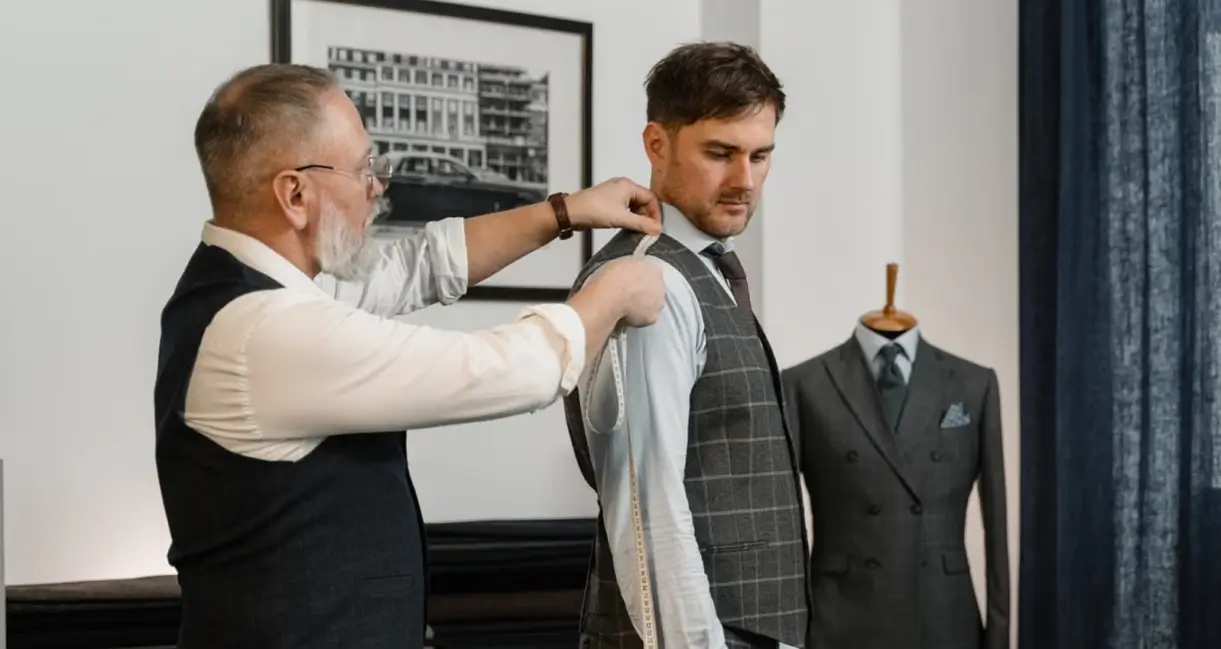
A grade rule only works if it starts from an accurate base measurement. The best private label programs treat the initial body measurement session as page one of quality control, not a formality to get through before pattern-making begins.
The Grade Rule: How One Sample Size Becomes a Full Range
A grade rule is the specification that tells a pattern how much to grow or shrink at each point of measure to produce every size in the range from a single base pattern - usually a size Medium or its equivalent. Industry starting points look roughly like this, though every brand adjusts them to its own fit model:
| Garment type | Point of measure | Typical increment per size |
|---|---|---|
| Tops | Chest / bust | 1 inch |
| Tops | Shoulder width | 0.5 inch |
| Tops | Body length | 1 inch |
| Tops | Sleeve length | 0.5 inch |
| Tops | Neck width | 0.25 inch |
| Bottoms | Waist | 1 inch |
| Bottoms | Hip | 1 inch |
| Bottoms | Inseam | 0.5 inch |
| Bottoms | Outseam | 0.75 inch |
| Bottoms | Thigh | 0.5 inch |
A one-inch-per-size chest grade applied to a 36-inch small. Every point of measure in the tech pack needs its own version of this ladder, not just the headline measurement.
Where Grading Actually Breaks Down: Multiple Factories, Multiple Interpretations
A grade rule written correctly in a tech pack is not the same thing as a grade rule executed identically on every cutting table. Two factories working from the same spec sheet can each apply a grading tolerance that looks negligible at any single size step - a tenth of an inch here, a tenth there - and still produce a noticeably different XXL by the time the tolerance compounds across five size jumps.
A 0.1-inch-per-size tolerance in either direction looks trivial at Medium. By XXL it's a 0.8-inch gap between two factories both technically "close to spec" - enough for a customer to feel it, even if no single measurement fails inspection on its own.
This is exactly the kind of fit deviation that AQL-based quality inspection often misses, because a single garment measured a fraction of an inch off spec still passes. The problem only becomes visible when the whole size curve is checked against the grade rule, not just individual units against a tolerance band.

Grading discipline shows up first on the cutting table, not in the size chart. A clearly documented grade rule keeps every factory's cutters working from the same numbers as the tech pack, order after order, instead of quietly filling in the gaps with their own judgment.
Why Extended Sizes Need Their Own Grade Rule, Not Just More of the Same One
The bar chart above works cleanly because a uniform one-inch-per-size chest grade is a reasonable approximation across a core size range. It stops being a reasonable approximation once a program extends into plus or extended sizes. Bodies don't scale up proportionally - the ratio between bust, waist, and hip measurements shifts as sizes increase, rather than staying fixed - so a straight-line grade rule built for a Small-to-Extra-Large range tends to produce a garment that's technically the right circumference at a 2X or 3X but wrong in proportion: too much fabric in one area, too little in another, armholes and shoulder points that no longer sit correctly.
The practical fix most experienced pattern teams use is a break point in the grade rule - one set of increments for the core range, a different, non-linear set beyond it, sometimes built from a separate block pattern rather than a pure mathematical extension of the sample size. A private label program that treats plus and extended sizes as "the same grade rule, just more of it" is one of the most common places size-related returns concentrate, and it's rarely caught in a fit session that only ever tests the sample size.
Where 3D scanning fits in
A growing number of private label programs are adding 3D body scanning and virtual fit simulation to catch exactly this kind of proportional drift before a physical sample is even cut. It doesn't replace an on-body fit session, but it's a fast, cheap way to flag a grade rule that's producing an implausible silhouette at the extremes of the size range, before that mistake costs a full sample and shipping cycle to discover.
Making the Grade Rule Actually Stick
- Put the full grade rule table in the tech pack, not just the base size spec. If a factory only receives the Medium measurements, they're generating their own grade rule by default - and it may not match yours.
- Specify a tolerance, not just a target. "+/- 0.25 inch" attached to every point of measure gives the factory's QC team something concrete to inspect against, rather than relying on judgment.
- Require a graded spec sheet back from the factory before cutting starts. Comparing their interpretation of the grade rule against yours on paper is far cheaper than discovering the gap in finished goods.
- Fit-test more than the sample size. A style approved only at Medium tells you nothing about whether the grade rule is actually correct at Small or XXL.
- Re-audit the grade rule when you change factories. A perfectly consistent grading history with one vendor doesn't transfer automatically to a new one, even with the identical spec sheet in hand.
Fit Testing Across the Whole Size Range, Not Just the Middle
Most fit sessions happen once, on a sample-size fit model, and the resulting approval gets treated as approval for the entire size range. That's the gap that lets grading creep go unnoticed until customer returns surface it. A more reliable process checks fit at three points on the curve, not one:
| Test point | What it catches |
|---|---|
| Smallest size in the range | Over-aggressive grading that makes the smallest size proportionally too tight or too short |
| Sample / base size | The core fit the whole grade rule is built from - this is the one everyone already checks |
| Largest size in the range | Compounded grading error, and whether proportions (not just circumference) still make sense at scale |

Fit testing across the full size range, not just the sample size, is what actually catches grading drift before it reaches a customer's own fitting room - and turns into a return instead of a repeat order.
This is a small addition to a development calendar - two extra fit sessions per style - against a return rate problem that, per the numbers above, can run into double-digit percentages of units sold. For a private label program building the kind of fit-focused development process described in our fit-focused product development guide, grading discipline is the technical layer that makes the strategy actually hold up at scale, past the first sample and past the first factory.
Seeing inconsistent fit across sizes or factories?
We help private label teams audit grade rules, tighten tech pack specs, and build a fit-testing process that catches drift before it reaches the customer. See our product development consulting services or get in touch to talk through your size range.